

reading
A selection of resources informing a contemplative approach to field recording practice.


Hiking Zen
Br. Phap Xa and Br. Phap Luu
Mindfulness can be practised in any posture—sitting, standing, walking, or lying down—all “doors” to present-moment awareness. Phap Xa and Phap Luu offer personal stories, insights and practices all woven together within the wider story of a 2200 mile pilgrimage from New York to Washington on the Appalachian Trail. In the book, they explore how mindful walking can be simple but transformative. By slowing down, matching breath to steps, and grounding attention in body sensations, they show how we can develop stability and respond more skilfully to personal and societal crises. Hiking Zen comes back again and again to the importance of each step, mindfully taken, and embodying aimlessness, the third door of liberation in Zen practice.
April 2025


Interdependence: Biology and Beyond
Kriti Sharma
I was drawn to this book because the title, and what I’d heard about the book, resonated with me and my interest in the interbeing nature of phenomena. In summary, Sharma argues that what is commonly called ‘interdependence’ in biology and culture assumes fundamentally independent entities that interact. She challenges this, proposing a contingentist framework in which things do not exist independently, but arise through mutual dependence. Interdependence really means that objects, organisms, subjects, and experiences are mutually constituted, not just related. Sensing, then, is not just the passive reception of an external world, but a process in which organism and environment arise together, being transformed simultaneously. Not a light read, as you can tell, but well worth the effort.
March 2026


The Zen Arts
Rupert A. Cox
A re-reading of this book, which seems even more relevant than it did when Prof. John Drever suggested I read it ten or more years ago. Cox argues that, while “Zen arts” has no direct Japanese equivalent and cannot be reduced to either ‘Zen’ or to ‘art’, the category remains useful because of shared forms, embodied disciplines, and aesthetic–spiritual values. Cox’s work adopts an anthropological approach that emphasises practice, social context, and lived experience. He critiques essentialist and Orientalist interpretations of Japan and Zen, arguing that authenticity emerges not from abstract cultural essences or texts alone, but more from the embodied, socially situated interplay between discourse and practice within specific communities.
February 2026


The Sound Inside the Silence
Seán Street
The interface, dialogue or membrane between interior and exterior silence/sound seems to be more widely written about in academic sound studies lately. Street's book traverses this membrane quiet freely and in a variety of contexts, looking at the interaction of the soundscape and sense of place, with our interior, imaginative thought-sound-world. This quote captures something of this: “Thus, place would seem to actively generate silence, while at the same time, our emotional engagement with an environment creates an imaginative dialogue, even though it is a wordless one. We have the capacity to impose our own inner silence on a space or a situation, but the world can get its own back on a chosen personal silence, by invading it with its own identity. It is for this reason that we must foster the art of listening at a deeper and more active level than, for the most part, our daily lives allow.”
January 2026


Zen Keys
Thich Nhat Hnah
Probably my fifth time of reading this book and does what it says on the tin' i.e. gives the reader the keys to unlock the the teachings pointing to the direct, lived experience of Zen. Not easy to summarise without doing the book an injustice, but this quote rings true for me: "Does Zen exist yet in the West as a living tradition? Many monks, nuns, and lay teachers are offering the practice of Zen there, but to me, much of the practice remains Oriental, foreign to Western culture. The process of Zen finding roots in Western soil is an ongoing one. Cultural, economic, and psychological conditions are different in the West. One cannot become a practitioner of Zen just by imitating the way of eating, sitting, or dressing of Chinese or Japanese practitioners. Zen is life, Zen does not imitate.
January 2026


Embrace Tiger, Return to Mountain
Chungliang Al Huang
Based on workshops offered to his Tai Ji students, Al Huang explores the essence that underlies the practice. Deeply inspired by Daoist and Buddhist praxis and drawing on the work of his friends Alan Watts (who writes the foreword) and Pauline Oliveros, there is plenty here for those who work with stillness in movement. You can see the cohabited space in quotes such as this:
“You must also use your ears. Let all sounds come into you without resisting or letting any of them bother you. Don't categorize them. Don't say, "That's the ocean—that's bird—that's him talking-that's kitchen—that's footsteps." If you keep identifying things specifically, then you become partial. Just allow yourself to sense everything, and to go through the whole emptying, relating process."
Thank you to my teacher Lesley for another great recommendation!
December 2025

Art, Creativity and the Sacred
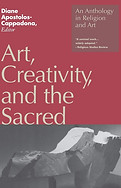
Apostolos-Cappadona (ed.)
Writings on (visual art) art and the sacred, Chapters that stood out for me:
-
4: Reflections on Art and the Spirit: A Conversation, De Staebler & Apostolos-Cappadona - exploring spiritual growth, finding equilibrium and letting go of religion in order to find it more fully. through arts practice
-
11: Foundations for a Religio-Aesthetic Tradition in Japan, by Richard Pilgrim - an introduction to Ma and Kú in Japanese art, growing out of Shinto and Buddhist experiences of reality and their outworking in art.
-
18: Art and Ultimate Reality, Paul Tillich - Tillich, an important early 20th Century theologian and philosopher explores the expression of 'Ultimate Reality' in art works and arts relationship with religion as means of apprehending 'Ultimate Reality.'
December 2025

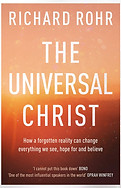
The Universal Christ
Richard Rohr OFM
Rohr sets out to reframe Christian belief in its universal form, stressing the ubiquitousness of God in Creation and exploring the theological outworking of this position - including original goodness (rather than a focus on original sin) and the importance of experiential knowing, mystical experience and contemplative practice as a means of grasping the divine mystery. Rohr also explores the implications for social and environmental justice: "Without a sense of the inherent sacredness of the world-of every tiny bit of life and death—we struggle to see God in our own reality, let alone to respect reality, protect it, or love it. The consequences of this ignorance are all around us, seen in the way we have exploited and damaged our fellow human beings, the dear animals, the web of growing things, the land, the waters, and the very air." While Rohr's use of scripture and his Christo-centric worldview may not be everyone's cup of tea, there is much in this book that had me nodding along enthusiastically.
December 2025
Psycho-spiritual Care in Health Care Practice
Guy Harrison (ed.)
While seemingly unrelated to my focus here on contemplative field recording practice, my exploration of care-full listening in healthcare settings has informed my field recording practice and my understanding of spirituality, mindfulness and care: "Caring is a word for being connected and having things matter, it works well because it fuses thought, feeling and action - knowing and being." As in Thich Nhat Hanh's practice of Engaged Buddhism, Harrison draws out the interrelationship of 'being' and 'doing,' perhaps translatable to 'contemplation' and 'action.'
December 2025

Zen Flesh, Zen Bones

Compiled by Paul Reps
Stories, parables and epigrams from over 500 years of practice in Japan and China, all pointing to the 'marrow' of direct experience. The title taken from this conversation:
Dofuku said: 'In my opinion, truth is beyond affirmation or negation, for this is the way it moves.'
Bodhidharma replied: 'You have my skin.'
Soji said: 'In my view, it is like Ananda's sight of the Buddha-land - seen once and for ever.'
Bodhidharma answered: 'You have my flesh.'
Doiku said: 'The four elements of light, airiness, fluidity, and solidity are empty and the five skandhas are No-things. In my opinion, No-thing [i.e. spirit] is reality?'
Bodhidharma commented: 'You have my bones.'
Finally, Eka bowed before the master - and remained silent.
Bodhidharma said: You have my marrow.
December 2025


The Heart of Centering Prayer
Cynthia Bourgeault
One of the most helpful books I've read in trying to better understand, not only the practice of Christian Centering Prayer, but the theory underpinning it. Bourgeault's work draws from neuroscience and sets Centering Prayer apart from Buddhist and secular mindfulness practices in its approach to the cultivation of 'objectless awareness.' There is a particular focus in the second half of the book on the Christian mystical classic 'The Cloud of Unknowing' reinterpreting key passages that may at first appear contradictory, but whose mystery may be unlocked by viewing them through the lens of attention and awareness. While I am familiar with the work of many Christian Contemplatives, I had not heard of the term 'Non-dual Christianity' before reading this book and am grateful to Bourgealt for bringing greater clarity to our understanding of Christian Centering Prayer.
December 2025
Into The Maelstrom: Music, improvisation and the Dream of Freedom (before 1970)

David Toop
This book grows, not only from extensive reading, but a life-time of practice, conversations and listening. This quote gives you a taste: "Sit, do nothing: this is improvisation. Allow stray thoughts, inner tremors, sensory impressions to pass through the body. To listen is to improvise: sifting, filtering, prioritizing, placing, resisting, comparing, evaluating, rejecting and taking pleasure in sounds and absences of sounds; making immediate and predictive assessments of multilayered signals, both specific and amorphous; balancing these against the internal static of thought. From moment to moment, improvisation determines the outcomes of events, complex trajectories, the course of life. Humans must learn to improvise, to cope with random events, failure, chaos, disaster and accident in order to survive."
November 2025

Noticing
Ziyad Marar
If you're new to the topic of attention, awareness and noticing, this book may provide an accessible, easy to read overview, full of well-known references and relatable links to popular culture. Marar has clearly spent time collecting quotes, film references, anecdotes and academic research that is organised into key themes and topics. Perhaps useful as an introduction for the non-specialist, I found myself quickly skimming through the pages of the book to find something that was novel and drew my spotlight of attention.
November 2025

What Happens in Mindfulness
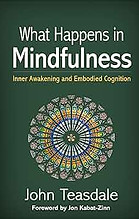
John Teasdale
John Teasdale's erudite writing explores links between contemporary mindfulness research and the insights of ancient contemplative traditions, particularly focusing on the longer term changes in mind-body from the practice and the little discussed 'awakened' mind. Difficult to summarise here, I'll use this quote instead: “Mindfulness offers a way to rebalance the relationship between our two ways of knowing—a way to put holistic-intuitive knowing [rather than conceptual knowing] back in control. A radical shift in relationship between our two ways of knowing is fundamental to both the mindfulness taught in mindfulness-based programs and the transformed consciousness of inner awakening. The key difference between these two modes of mind is that awakening requires a further radical letting go of all goals related to becoming a different kind of self. This degree of renunciation requires fundamental changes in the way we see the world and in the way we relate to it. It involves a basic reorientation from our habitual sense of separation, disconnection, and preoccupation with our own agendas to awareness of our interconnection with, and care for, all of life.” pp.4-5
November 2025


Centering
M.C.Richards
While I found are moments of interest in the book, Richards' writing seems to wander between her own thoughts and experience, and others' wisdom writings freely and with little sense of structure. I found myself glossing over sections and did not feel connected to the art of the potter, the wisdom that making fostered or the theme of centering.
November 2025

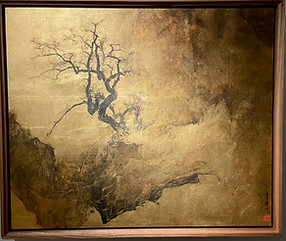
Trees and Mountains on Gold and Silver
Li Huayi
An intimate exhibition of ink paintings at Eskenazi Art Dealers in London. Exploring traditional themes of Chinese Landscape painting, although notably without human figures. This left the focus on 'heaven' and 'earth' balanced in colour, material and subject. Inky, aged and knotted trees grow on craggy mountains that disappear into cloud, empty space and imagination, gold leaf offering the paintings as altar pieces.

October 2025

Sound Poetics: Interaction and Personal Identity
Seán Street

Seån Street brings together a range of voices and ideas from the field of sound studies, to explore topics such as sound, silence, imagination, soundscape and self. The book covers a lot of ground and while I was longing for more depth than breadth, that was not the aim of the book, which navigated an engaging mix of ideas, brought to life with personal anecdotes, examples, quotes and the occasional story. The last paragraph, to me, seems to capture something of the author's broad direction, but also intention: "To communicate our true sound is a right and a duty. It is part of the sound of our own time and place. We might ask, what would be the voice with which we as a species would wish to be heard by other worlds in the universe? To dwell on that thought would be to open a debate of bewildering complexity. For now, it is best that we begin with ourselves, listen critically, carefully and compassionately, and express ourselves with sound that remains faithful to our unique human existence, part of the world, but a world in ourselves at one and the same time.” p.110
October 2025

Seven Thousand Ways to Listen
Mark Nepo

Mark Nemo clearly reads widely and there are a variety of personal anecdotes that relate to the various themes covered. The book is full of inspirational quotes and references from all manner of religious and philosophical traditions. I did, however, stop reading about 60 pages in. I felt listening was, to a great extent, simply used as a vehicle for a wider exploration of the worlds wisdom traditions and I longed for him to explore the themes in more depth. The reflections and examples seemed to jump from one topic to another without a real sense that they had been explored and drawn together. The addition of meditations and questions for reflection was a nice touch, inviting the reader to explore the topic. However, I felt there was a missed opportunity to engage with the act and art of listening as a means of prompting personal insights. Nemo's sincerity, personal stories and inclusiveness comes through his wirting but, for me, the engagement with the topic of listening seemed light and cursory.
September 2025


Walking, Listening, Soundmaking
Elena Biserna (ed.)
A surprisingly comprehensive history and anthology of soundwalking practices. Part I begins by exploring key historical developments in walking, listening, soundmaking practices and then goes on to look at a wide variety of, largely, arts-based pieces, gathering them together in a way that implicitly and explicitly draws-out resemblances. Part II then gives voice to the artists and creators, again grouping by topics such as ‘Spaces for Publicness’ and ‘Walking Bodies.’ This book will be staying on my shelf as a go-to reference for examples of soundwalking practices.
August 2025


China Root
David Hinton
The project of dismantling widespread misconceptions about Ch’an Buddhism (particularly the Japanese Zen tradition popularised in the US and Europe) while reinstating the centrality of the Tao in these traditions, could only be eloquently and authoritatively achieved by someone as familiar with Chinese literature, philosophy and poetry as David Hinton. Returning Ch’an again and again to its China Roots – in short, that primal wholeness that is absence (the empirical Cosmos experienced as a single generative tissue), and presence (the Cosmos seen as the ten thousand things in constant transformation) - Hinton’s work restores Ch’an forms of Buddhism to their proper context as part of a pre-existing Chinese philosophy, practice and history.
August 2025

Poetics of Listening
Brandon LaBelle
What grabs me about this book is its breath and courage to move into areas of listening that are not the normal purview of sound studies. LaBelle's approach, one that takes listening as poetry and highlights the poetic communication of our listening and understanding, sat comfortably with me as I read. Labelle writes that “listening often stretches binary thinking” and I enjoyed the way that the book explored topics openly and without trying to tie concepts down too tightly. While I would have found it an easier and more engaging read if it was grounded in examples and personal experiences of listening, the way that LaBelle draws together authors from a vast array of disciplines is heartening, using the language of poetry, care, compassion, interconnection, and bodily 'listening-with'.
July 2025


Conjectures of a Guilty Bystander
Thomas Merton
A contemplative classic, and you can tell why. Every couple of pages I would need to stop and ponder nuggets of wisdom that calmly and thoughtfully grapple with everything from war, communism, capitalism and the political landscape of the 1960's, monastic life, Christian contemplative spirituality, theology, personal and social action, protest and nonacquiescence and much more besides. Underlying and punctuating these 'conjectures' is the delicately held tension between solitude as passivity and limitation, and solitude as action and liberation, its place for Merton, but also in modern societies more widely. While the social and political landscape of the US may have changed, so much of what is grappled with by Merton remains tremendously prescient.
June-July 2025